

Vocal music at the beginning of the ninth century and earlier was monophonic, and harmony evolved from unison singing to singing in octaves. Octave doubling was probably a necessity when combining high and low male voices or in mixed-choir practice. More interesting is the early organum that emerged toward the end of the century, in which the newly composed voice (vox organalis) sang in parallel fifths or fourths above or below the original plainchant voice (vox principalis), sometimes with octave doubling in either voice. In Figure 1, I use a cantus firmus from J. J. Fux’s treatise on counterpoint, Gradus ad Parnassum, as the vox principalis, adding a parallel fourth below as the vox organalis, then a third voice singing the C.F. an octave lower to create a mock-up of a hypothetical strict parallel organum:

You can see that this three-part voicing matches perfectly with the intervallic structure of the second, third, and fourth overtones. Thus, composers of ancient times intuitively recognized these lower overtones and revolutionized the concept of harmony. From monophonic music comprising unisons and octaves came polyphonic music with the addition of the perfect fifth and fourth. These intervals were considered consonances. Nowadays, we call them “perfect consonances” because they have been regarded as pleasing sounds since early times. At least, they sounded good to musicians in the ninth century. Later, when tastes began to change, other intervals would also come to be regarded as consonances. But back then, only these were considered consonant.
“But what about the third and the sixth?” you ask. Well, surprisingly, they were considered dissonances at that time—or at least less consonant than we perceive them today. You do not hear them that way because your ear has been conditioned by countless musical examples from the Baroque, Classical, and Romantic eras, to say nothing of the many fine pop songs of today. In the old days (that is, the ninth century), composers had to be careful still when introducing the third. Theoretically, this is as it should be. The third (and the sixth, which is its inversion) arises from a higher overtone and therefore has a lower amplitude, making it more dissonant. Its use was largely confined to passing sonorities and never at the beginning or end of a phrase. The seventh, second, and tritone, still farther up in the series, were likewise treated as strong dissonances and required careful handling.
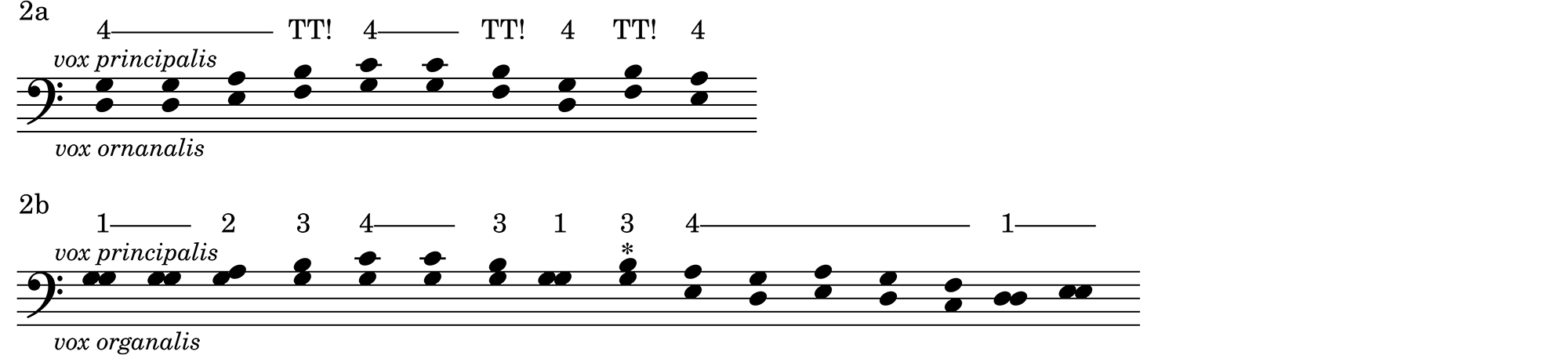
Figure 2 shows a parallel organum at the fourth below, where you can see the careful use of the second and third. If the composer were to write parallel fourths from the beginning, he would end up with a tritone once the melody reaches B (see 2a). Instead, by sustaining the G throughout the first part (2b), the music begins with a unison (as it should), then progressively widens the interval through the dissonant second (G–A) and third (G–B), successfully avoiding the F–B tritone before finally reaching the fourth on the fifth note of the melody (G–C).
Over time, the static, stable quality of the perfect consonances favored in early organum must have come to seem monotonous. The third, derived from the fourth overtone of the harmonic series, on the other hand, was becoming increasingly popular, not least because of its slight dissonant quality, which perhaps made it more interesting.
By the twelfth century, the third and sixth were used frequently. That they were considered consonances by composers of the fifteenth century is demonstrated by the French compositional technique known as fauxbourdon, in which a chant was placed in the top voice while a newly composed voice moved in parallel sixths beneath it. In performance, a third voice was added, singing in parallel fourths below the top voice. The overall result is a succession of what we would today call first-inversion triads. In Figure 3, the red circles represent this new sonority, favoring the third and sixth, while the blue circles represent the older sonority of octave and fifth.

These new consonances—the third and sixth—are today labeled imperfect consonances, as opposed to the perfect consonances, because they were once considered dissonant. They added greater depth and shading to the music. To musicians of the fifteenth century, the lush sound of these intervals in succession must have been irresistible. They produced a trendier sound. The third and sixth were modern. The open fifth and fourth, favored five centuries earlier, gradually became obsolete. Their unquestioned place remained only at the beginnings and endings of phrases, where composers still needed a sense of stability and repose.
The seventeenth century saw the final stage of the gradual paradigm shift from modality to tonality. The tonic–dominant polarity was firmly established through the use of triads. Chords containing imperfect consonances became the norm, even at the beginning of a phrase and at cadential points. Perfect consonances by themselves, without the third or sixth, were generally avoided because they evoked the older style of composition. Music from the seventeenth through the nineteenth centuries—that of Vivaldi, J. S. Bach, Haydn, Mozart, Beethoven, Brahms, and even Wagner—favored the third/sixth pair while continuing to treat the second, seventh, and tritone as dissonances that required specific handling.
Figure 4 shows parallel thirds between the melody and bass for much of the phrase (see blue color). You can also see the careful treatment of dissonances (red color). In m. 4, the ninth resolves to the octave, and the fourth resolves to the third. (In this context, the fourth is treated as a dissonance—an elaboration of the third.) Another interesting dissonance occurs in m. 2, where the bass G# on beat 1 and the melodic note D on beat 2 form a tritone. This diminished fifth does not resolve until m. 4, where the dissonant D resolves to C# while the leading tone G# moves up to the tonic A.

From the seventeenth century to the end of the nineteenth century, although the third reigned supreme, the tension between consonance and dissonance continued to intensify. Like the perfect consonances before it, the third and sixth gradually lost ground to the more intriguing second, seventh, and tritone. In the music of Wagner, Richard Strauss, and Mahler, it is not uncommon for these dissonances to be sustained over long passages before finally resolving.
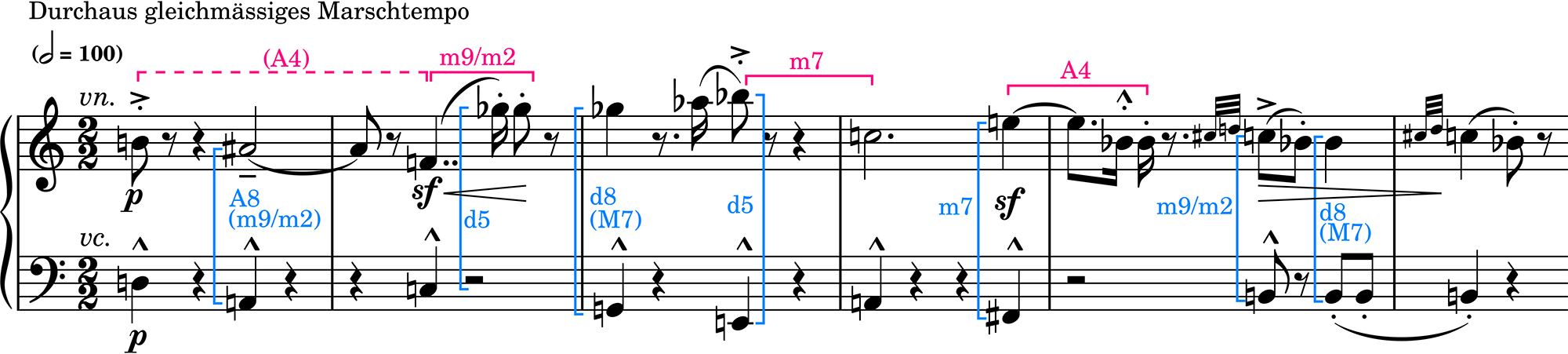
The next paradigm shift came toward the end of the first decade of the twentieth century, when Arnold Schoenberg “emancipated” dissonance, thrusting music into the world of atonality, where tonic–dominant polarity lost its strength and “dissonant” simply came to mean “less consonant.” Dissonance and consonance became differences of degree rather than kind. “I feel the air from another planet,” the soprano proclaims in the opening verse of Schoenberg’s String Quartet No. 2, and it is indeed a different world—a world in which dissonances can and do play a primary role without any need for resolution. The second, seventh, and tritone govern much of the music written from the twentieth century onward, as can be seen in Figure 5. Harmonic dissonances are marked in blue, and melodic dissonances in red.
Thus, the evolution of harmony follows a path that begins at the fundamental tone and gradually ascends the overtone series. The higher one climbs, the less familiar the intervals become, since the corresponding overtones are typically softer. One should also note that the higher overtones are packed more closely together than the lower ones. Beyond a certain point, the distance between consecutive overtones becomes smaller than a semitone. Microtonal composition from the second half of the twentieth century onward may therefore be viewed as a further logical evolution of harmony. Likewise, spectral music, developed in the 1970s, may be understood as the use of the entire overtone series as source material.
If you are beginning to feel that the scope of harmony is overwhelmingly large, you are not alone. Fortunately, we will limit our study to tonal harmony, focusing primarily on music written between the seventeenth and nineteenth centuries—the so-called Common Practice Period, encompassing the Baroque, Classical, and Romantic eras. Early modal music based on church modes and atonal music of the twentieth century lie outside the scope of our discussion for now. On appropriate occasions, however, we will dabble in examples from the twentieth and twenty-first centuries, provided they remain tonal. These include a considerable amount of pop, rock, and jazz music.
As we can see, the overtone series exerts an all-encompassing influence on harmony. It would not be an exaggeration to say: when in doubt, consult the overtone series!