

Harmony is not a static concept. Rather, it behaves much like a living thing, transforming over time. The direction of this transformation is governed partly by an interesting acoustic phenomenon called the overtone series.
To hear this in action, let’s try a quick experiment: with your right hand, press and hold down a G below middle C (G3) on a piano silently so that its hammer is lifted from the strings and the strings are free to vibrate. (You need an acoustic piano for this; a MIDI/electric piano won’t do.) With your left hand, play a loud staccato note an octave and a perfect fifth below this G. That would be the C two octaves below middle C (C2)—coincidentally, the lowest note of a cello. Once the short, loud sound of C2 is gone, surprisingly, you should be able to hear a soft ring of G3.
How is this possible? It’s because there is a G3 hiding inside C2! When you play C2, the air doesn’t just vibrate at the C2 frequency; it vibrates in a much more complex way, incorporating the frequency of G3 (and more!) as well. This causes the strings of the actual G3 (which you already pressed silently) to vibrate sympathetically, producing the soft ring of the note.
A tone produced by an acoustic instrument is usually a complex collection of tones comprising a fundamental note (the note that you play—C2 in our experiment) and other related notes above the fundamental (notes that are not being played but are there anyway, like G3). These notes are called overtones. Together they form the overtone series. The first overtone is an octave above the fundamental; the second overtone is an octave and a perfect fifth above it; the third is two octaves above. Each successive overtone is progressively higher. The first four overtones of C2, for example, are C3, G3, C4, and E4, respectively. The fundamental tone is sometimes referred to as the first partial. In this system, the first overtone is called the second partial, and so on. Figure 1 shows the fundamental tone C2 with its first 11 overtones.
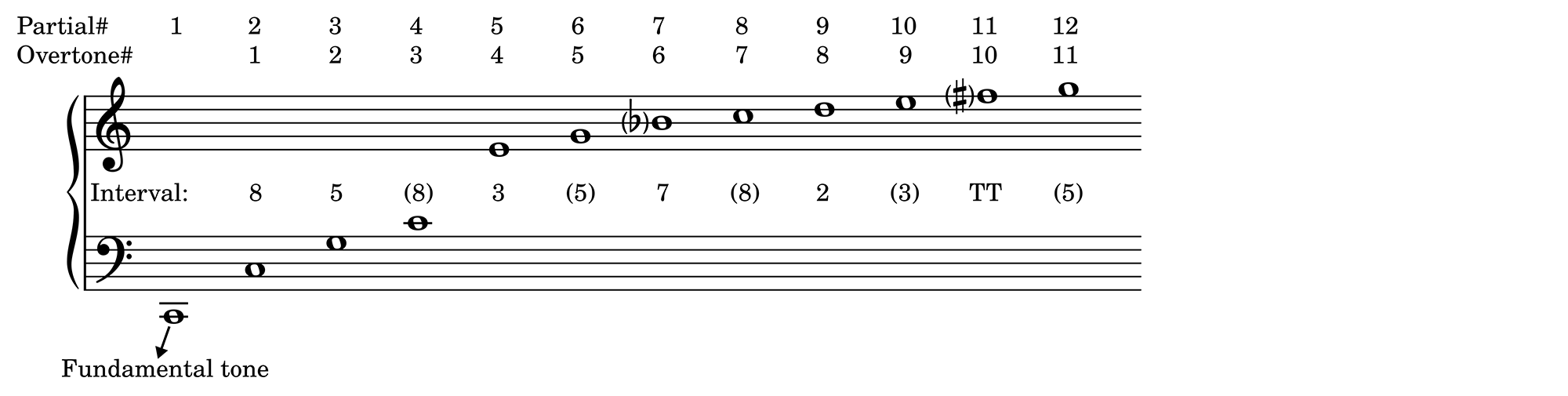
After studying Figure 1, you probably want to ask, “Why didn’t I hear C2 with all its overtones as a C7(9,#11) chord?” Well, firstly, the overtone series doesn’t end at the 11th overtone; there are more notes above G5. So, if you can hear them all (and I’m doubtful!), the chord would be more complicated than C7(9,#11). Secondly, the 6th overtone is noticeably lower than the ordinary Bb in 12-tone equal temperament. Likewise, the 10th overtone is in fact almost halfway between F5 and F#5 (a little closer to F#5). So, the C7(9,#11) wouldn’t sound as you might expect: it would be out of tune. And thirdly—and probably most importantly—overtones have much lower amplitudes than the fundamental, so much so that their pitch identities are masked by the louder fundamental note. Most people do not perceive overtones as individual notes but instead hear their combined effect with the fundamental as a single pitch rather than a chord.
Interestingly, different musical instruments have different overtone-amplitude profiles. These differences in the loudness of each overtone are part of the reason why we can distinguish an oboe playing E3 from a clarinet playing the same note.
The overtones contribute significantly to what we call the tone color, or timbre, of an instrument.
Generally speaking, lower overtones tend to be louder than higher ones. You can modify our earlier experiment by pressing E4 silently instead of G3. Then play the same C2, loud and short, wait for it to die down, and you might hear the E ringing softly. Notice that you may have to play C2 louder than before to trigger the E. This is because the 4th overtone (E4) has a lower amplitude than the 2nd overtone (G3).
And here lies a very important implication of my long and winding story about the overtone series. Since lower overtones are louder, they are easier to hear and therefore more familiar, and thus tend to be perceived as normal, mellow—many would say “beautiful”. Higher overtones, on the other hand, are softer, making them harder to hear, less familiar, strange, harsh—some would say “ugly”.
We have now moved from the domain of acoustics to that of aesthetics. But the artistic consideration is still very much related to the practical side. If I play a low C on a cello and ask you to sing the same note, along with the cello but an octave higher, I think I can trust that you can do it with correct intonation because the octave, being the first overtone, should be very familiar to everyone. (And if you can’t, well . . . you will read my Aural Skills practice lessons once I get around to writing them, won’t you?) However, if I play the same C and ask you to sing, without much delay, a tritone above it (F# or Gb, corresponding approximately to the 10th overtone), I would be much less confident that you could do it quickly. It’s not that I don’t think you can, per se, but rather that it is genuinely more difficult.
The lower overtones are considered “consonant”: easy on the ear and easy to comprehend. The higher overtones, by contrast, are “dissonant”: harsher sounding and more difficult to perceive.
The treatment of consonance and dissonance by composers has been an important force in shaping harmony throughout different eras.
An important question now is this: which overtones are low enough to be considered consonant, and which are high enough to be labeled dissonant? Looking back, there seems to be a clear pattern: the concepts of consonance and dissonance have always changed over time. Significantly, the evolution of Western harmony has more or less coincided with a progression from the fundamental toward the higher overtones.
Exercises
OK, it’s time to check how well you know the overtone series . . . Write the first through fifth overtones of the following fundamental notes:

Check the answers: