This one is quite old—from 2014. Its origin is a bit hazy, so I’d better write it down before I forget it. One clear inspiration for this work was high-speed photography. Like any guy, I loved geeky tech, and at the time, high-speed video cameras—those that can capture motion and freeze frames of, say, a speeding bullet slicing through a playing card—were still very expensive. So I did my best: I attached a fixed-lens Fuji to a tripod, locked the shutter speed and aperture, stepped in front of the camera, imagined the air as thick as molasses, and swung my arm down heavily (but slowly—remember, the air is very thick), while Prinda pressed and held the shutter button for about five seconds, taking multiple photos as fast as the camera could manage. These photos were then stitched together to create a stop-motion parody of high-speed photography footage.
It must have been around a festive time, because Prinda brought home a blue balloon left over from a school party. We also had this strange hybrid of a high chair and a short ladder painted bright red, so we thought: why not place the bright blue balloon on this bright red thing, push them up against a bright white wall, and make a minimalist shot? The result is what you see in the video below. Poor man’s high-speed photography? Sure—but it was fun.
As for the sound, the idea was to imagine what it would sound like (metaphorically, not physically) if you stretched a split second into five minutes—the moment of my arm swinging down to destroy the balloon perched on top of the ladder. The one-directional buildup of tension is simple and suits the minimalist image well. The complexity of the electronic texture balances the simplicity of the visual elements.
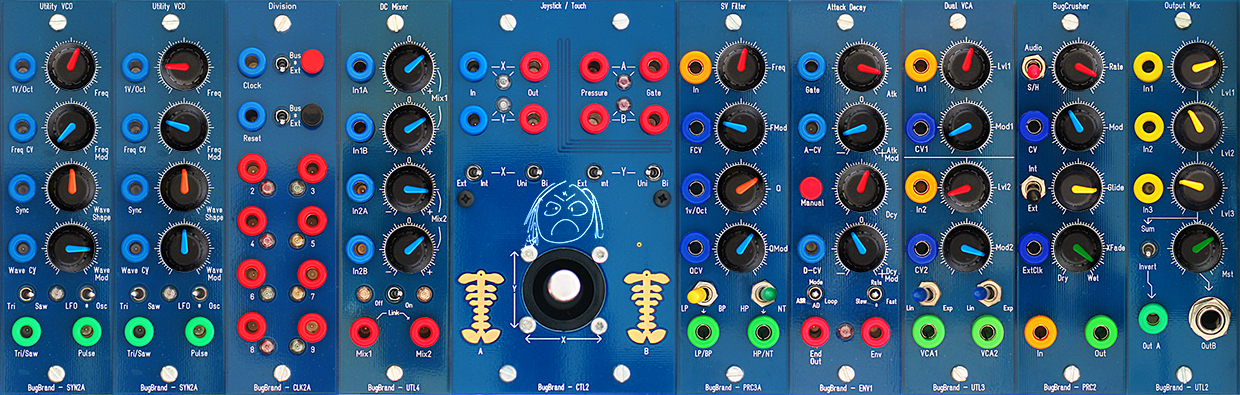
And the source of that complex sound? Although I still don’t own a high-tech high-speed camera, I do have a unique modular synthesizer. The BugBrand modular system is designed and built in Bristol by Tom Bugs. Since this is a true cottage industry, finished modules were hard to come by. Back then, you had to click “Order” immediately whenever something became available. It didn’t matter that I had a VCA and a VCF without even owning a VCO, because it could be months before I managed to beat everyone else to one—or before a new batch became available.
It took me more than a few years to complete my two-rack setup, mostly by acquiring those seemingly less interesting utility modules first. In the end, those modules taught me a great deal about modular synthesis, especially since Tom’s designs operate at low level. I learned how to make sound without proper VCOs first. And although I still don’t have his beautiful sequencer module, I discovered that using various clock dividers, switching modules, and logic modules could be even more powerful—and perhaps better suited to my compositional approach. The sound in Shale Sea comes from two main patches on the BugBrand, plus a bit from two secondary patches to thicken certain frequency ranges, all performed and recorded live.
And if you’re worried about the seemingly violent ending, I’m happy to report that the bright blue balloon was perfectly safe after the shoot. It kept its happy, air-filled shape and was annoyingly knocked around the floor for at least a week before the physics of material density and air pressure slowly deflated it, allowing it to come to a peaceful, natural rest in the end.