

A few weeks ago, Apple Music decided it should let me know about the new Taylor Swift album. The last album of hers that I listened to came out during the COVID-19 years—the one with the black-and-white cover. So, I played the first track, expecting the usual professional mix and a clean diatonic melody accompanied by simple harmony.
But once the first vocal phrase ended, I found myself doing an aural version of a double take. Then the phrase repeated, and it happened again. So, it was intentional. If you’ve already listened to The Fate of Ophelia a few times, your ear is probably attuned to this oddity and you might not notice it anymore. But if you haven’t, try listening to the first couple of vocal phrases—you’ll hear what I mean. Interestingly, after these opening phrases, the melody and harmony gradually come together, and the ambiguous tonality resolves itself.
Here’s the simplified melody of the first phrase:

The phrase centers around the main pitches G and Bb (blue note heads, Figure 1). Given that it’s diatonic, the melody could be either in F/Dm or Bb/Gm. For most musicians, it probably feels more like Bb/Gm because of those main pitches that also happen to be the tonic notes of the two related keys (again, blue note heads above).
However, Max Martin, Shellback, and Swift opted for F/Dm instead. In this case, neither of the tonic notes (F or D) appear in the phrase at all. Here’s the chord progression they used in this phrase and in the majority of the song. (Figure 2. Red note heads are nonchord tones—defined just for this post as any notes that are not the chord root, third, fifth, AND seventh):
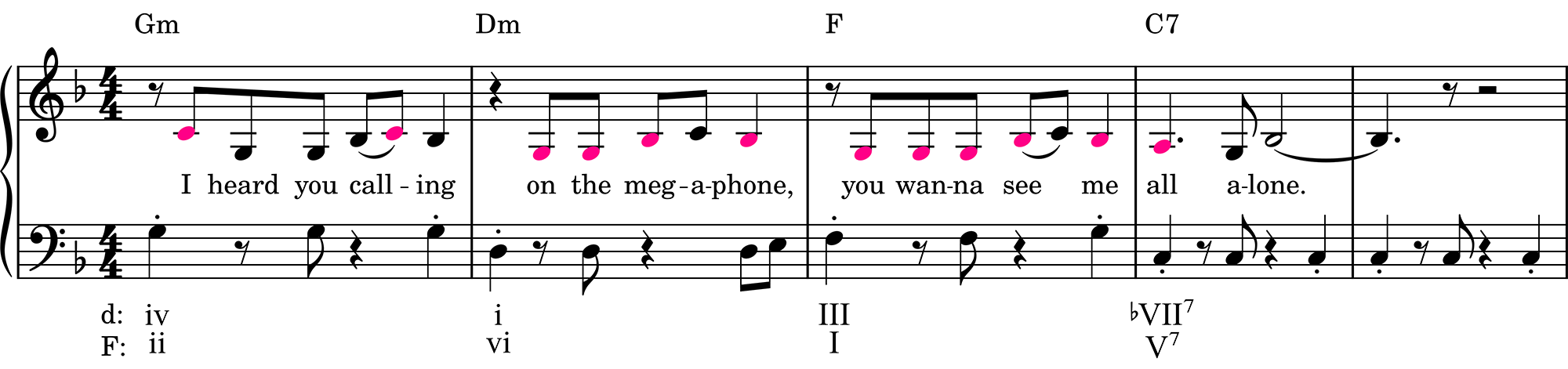
There’s nothing strange about the root progression itself—a reverse circle of fifths (G–D) followed by an F–C sequence. You’ve heard examples of root movements like this before—Hotel California comes to mind. What’s unexpected is the pairing of Dm and F chords in measures 2–3 with the main pitches AND nonchord tones G and Bb. It sounds a bit . . . off, at least at first hearing.
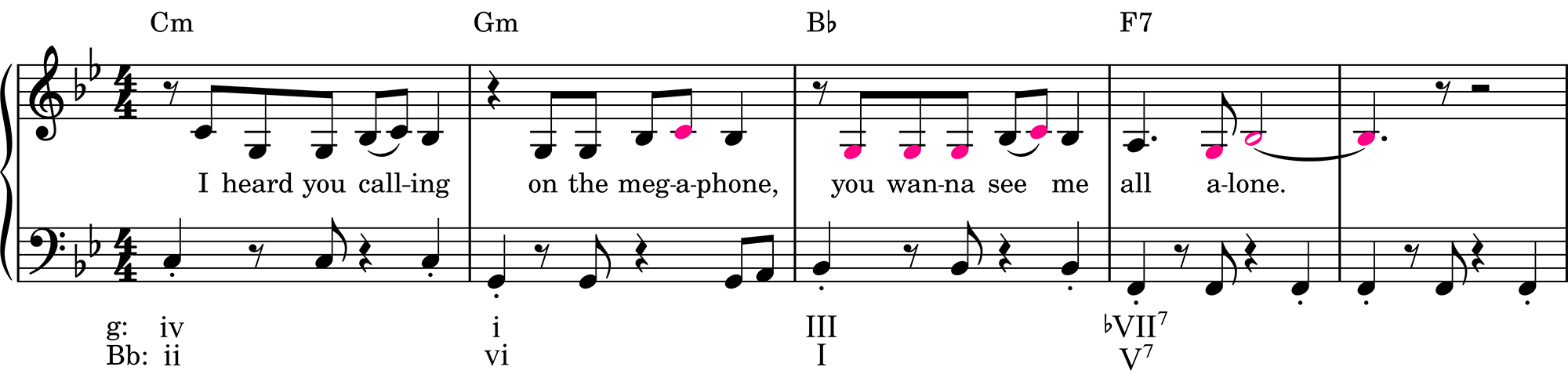
Now, what if we reinterpret the melody as if it were in Bb/Gm instead? Let’s keep the melody the same but transpose the instrumental parts up a perfect fourth (or down a perfect fifth), maintaining the same harmonic functions, i.e., the same Roman numerals (Figure 3). What does that sound like? To me, it feels “proper.” There are more chord tones in mm. 2-3, especially if you treat the Bb as Bb6 chord, so the G now becomes a chord tone. No harmonic weirdness in the first three measures anymore, but the F7 sounds weak despite the solid root motion into and out of the chord: the G and long Bb nonchord tones threaten to change the chord:
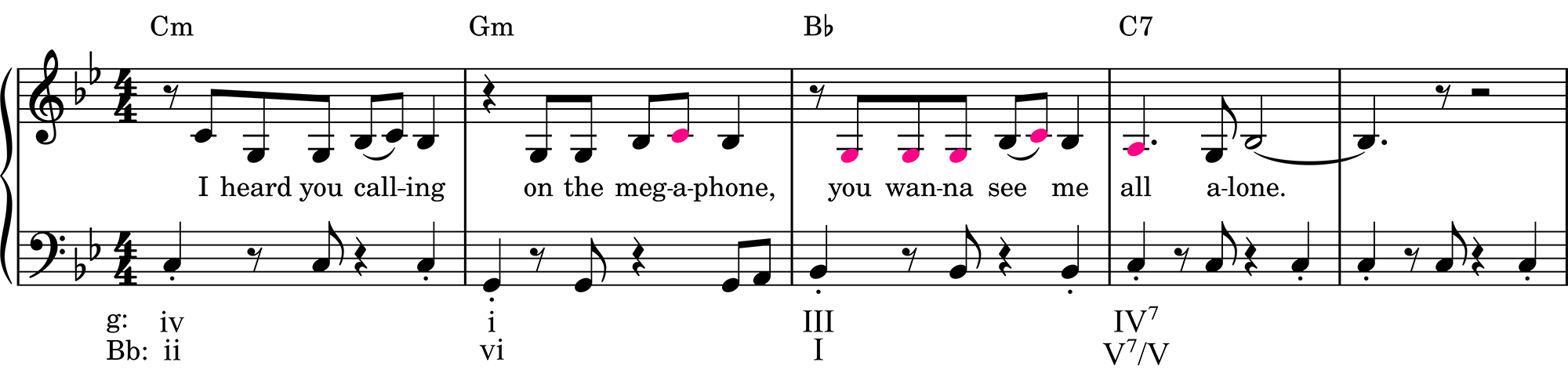
Let’s keep most of Figure 3 and just change that F7 back to the original C7. Everything sounds very proper and natural again. The offensive long Bb at the end of the phrase becomes chord seventh. The C7 is now analyzed as IV7 in G minor or V7/V in Bb (Figure 4). The only drawback is the repeating root note from C7 to Cm when the phrase repeats:
In the end, though, the producers must have decided it was worth sticking with the original interpretation, despite the strange clash between melody and harmony in measures 2–3. The later phrases resolve the issue anyway, and the gradual shift from that initial “off” feeling to the bright F-major tonality in the chorus builds a dramatic arch.
What does all this mean? Maybe nothing much, but it does show how tolerant of “tonal tweaking” a simple pop melody can be. That’s the nature of good pop songwriting, perhaps. It also demonstrates how great drama can emerge from deceptively simple ideas, and how simplicity, by its very nature, allows for flexibility—a malleable state perfect for endless manipulation.